
Learn how credit works and improve your credit score.
Simple financial knowledge designed for working South Africans. Explore practical guides and tools for budgeting credit, and saving.
Budgeting
Learn how to structure your income and control spending.
Credit
Understand how credit works and improve your score.
Saving
Build financial stability and prepare for the future.
Debt Management
Learn how to reduce and control debt.
SAVING
Emergency Fund Strategy: How to Build Financial Safety on Any Salary :
By Moniply Financial Education Team | 6 min read | Saving
An emergency fund is the foundation of every sound financial plan. Without one, a single unexpected expense — a car repair, a medical bill, a job loss — can push you into debt. With one, you have the buffer to handle life’s surprises without derailing your financial progress.
Why Most South Africans Don’t Have an Emergency Fund
A 2023 survey found that the majority of South Africans would not be able to cover an unexpected expense of R5,000 without borrowing money. This is not because people do not want to save — it is because saving feels impossible when money is already stretched.
The most common reasons people give for not having an emergency fund are:
• ‘I don’t earn enough to save’
• ‘I’ll start saving when things settle down’
• ‘Something always comes up and I end up using it’
All three of these are problems of structure, not income. An emergency fund does not require a high salary — it requires a system.
What Is an Emergency Fund?
An emergency fund is money set aside specifically for unexpected, non-negotiable expenses. It is not a savings account for a holiday or a new phone. It is a financial buffer that protects you from having to borrow money when something goes wrong.
True emergencies include:
• Job loss or sudden reduction in income
• Unexpected medical or dental expenses
• Essential car or appliance repairs
• A family crisis requiring immediate financial support
A new pair of shoes on sale, a birthday party, or an unexpected bill you should have anticipated (like a car service) are not emergencies.
How Much Should You Save?
The standard recommendation is 3 to 6 months of essential expenses. For most South Africans, this is more achievable than it sounds when you break it into stages:
|
Stage
|
Target Amount
|
|---|---|
|
Stage 1 (Start here)
|
R2 000 — one small emergency covered
|
|
Stage 2
|
R5 000 — covers most unexpected expenses
|
|
Stage 3
|
1 month of essential expenses (e.g. R8 436)
|
|
Stage 4 (goal)
|
3–6 months of essential expenses
|
Moniply example: Thabo’s emergency fund target
Thabo earns R12,978/month. His essential expenses are R8,436. His 3-month emergency fund target is R25,308. His Moniply Money Plan allocates R441/month to emergency saving — meaning he reaches his Stage 3 target (R8,436) in 19 months without any extra effort.
Where to Keep Your Emergency Fund
Your emergency fund needs to be:
• Accessible — you must be able to reach it within 24–48 hours
• Separate — not in your everyday account where it can be spent accidentally
• Low risk — not invested in shares or unit trusts that can drop in value
Good options in South Africa include:
1. 32-day notice account
Offered by most major South African banks. Earns better interest than a cheque account but requires 32 days’ notice to withdraw — which is fine for most emergencies that aren’t truly immediate. Good for Stages 3 and 4.
2. Money market account
Available through banks and investment platforms. Earns competitive interest rates and allows same-day access. Ideal for your full emergency fund once you have built it up.
3. Savings pocket at your bank
Most South African banks now offer instant-access savings ‘pockets’ or ‘goal accounts’ within your banking app. They earn slightly better interest than a cheque account and keep your emergency fund visually separate from your spending money. A good choice for Stages 1 and 2.
How to Build Your Emergency Fund Step by Step
Step 1: Open a separate savings account or pocket today
Do not wait. The account separation is what makes the system work. Even if your first deposit is R100, open the account now.
Step 2: Automate your contribution
Set up a debit order or scheduled transfer for the day after your salary arrives. Even R200 or R300 per month compounds into a meaningful fund over time. Thabo’s Money Plan allocates R441/month — worked out as 3.4% of his salary.
Step 3: Top it up when you can
Any bonus, tax refund, or unexpected income should go straight into your emergency fund until you reach Stage 3. Discipline at this stage accelerates your progress dramatically.
Step 4: Replenish it when you use it
If you use your emergency fund, treat replenishing it as your top financial priority. Temporarily reduce discretionary spending until the fund is restored to its previous level.
Step 5: Do not touch it for non-emergencies
This is the hardest part. When you see a balance growing in your savings account, the temptation to use it for non-emergencies is real. Label the account clearly — ‘EMERGENCY FUND — DO NOT TOUCH’ — and treat it as untouchable.
Building an Emergency Fund on a Tight Salary
If your salary is fully committed to essential expenses and debt repayments, finding money to save feels impossible. Here are practical ways to find R200–R500 per month:• Review your data and airtime spend — most people overpay for data relative to what they use
• Reduce takeaway meals by one or two per month
• Review all store accounts and clothing accounts — pay the minimum and stop adding to them
• Sell unused items — clothes, electronics, furniture you no longer need
• Ask your employer about any unclaimed benefits, increases, or overtime opportunities
The goal in the early stages is not the amount — it is the habit. Even R100 per month consistently moved to a separate account is the beginning of a financial safety net.
Moniply Free Money Plan
Your Moniply Money Plan automatically calculates an emergency saving amount based on your income band. Log in at moniply.co.za, complete your profile, and see exactly how much to save each month — and where it fits in your overall budget

Budgeting by Income Band
A structured budgeting approach based on how much you earn.
- What percentage should go to the bills.
- How much you should save.
- How to control lifestyle spending.
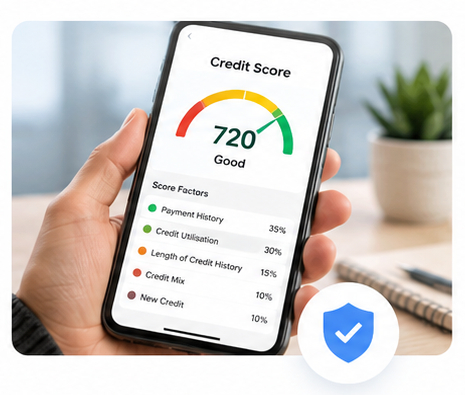
Understanding Credit Scores
Understand how credit bureaus calculate your score.
- Learn :
- What improves your credit score.
- How not to damage your credit profile.
- How to build a stronger credit record.

Emergency Fund Strategy
Learn how to build financial safety for unexpected expenses.
- Learn :
- How much to save.
- Where to keep your emergency fund.
- How to build it even on a tight budget.